Your questions about voltage, power supply, and installing your luminaires are answered by our team of experienced horticulture lighting technicians. Whether you are planning a new LED installation, adding supplemental lighting, or converting an existing HPS facility to LED, the electrical questions come first. Getting them right determines your fixture options, your installation cost, and your system efficiency.
Grow Light Voltage at a Glance
| Best voltage to use | The highest voltage available at your facility. Higher voltage means lower current draw, smaller conductors, and lower wiring losses. |
|---|---|
| Common commercial supplies | 480/277V three-phase (larger United States facilities) and 600/347V three-phase (larger Canadian facilities); smaller commercial buildings are often 208/120V |
| Typical LED fixture ranges | Many current P.L. Light Systems LED fixtures accept ranges within 208-480V; vertical and under-canopy fixtures start at 120V (exact range per fixture in the table below) |
| Do grow lights need 3-phase? | No. Luminaires are single-phase loads, but they can run off one or two legs of a 3-phase supply. |
| First step | Have an electrician confirm your available voltage, then match fixtures to it (or bridge with a transformer) |
Applies to North American commercial horticultural lighting installations. Always verify the fixture nameplate and specification sheet, and confirm your design against local electrical code with a licensed electrician.
What Voltage Is the Best to Go With for My Application?
We suggest going with the highest voltage available at your facility, which will also be the most efficient. Using a higher voltage for your application can lower driver and conductor losses and increase efficiencies.
Refer to our luminaire spec data sheets for the relationship between voltage, wattage, and amperage.
What Voltage Do I Have in My Building?
Since there are so many field combinations of voltages, an experienced electrician is needed to evaluate your particular site/facility to determine what you have available. The most common voltages will be:
Single phase:
- 120/240V
3 Phase:
- 208/120V
- 480/277V (most common in the United States)
- 600/347V (most common in Canada)
- 400V (special applications)
With the Power Supplies Listed Above What Voltage Can I Use to Run My Luminaires?
Once you know what voltage you have in your building you can move forward with deciding what voltage to use to power your grow lights. If you want a specific voltage installed, transformers can supply voltages not currently installed in your facility. We always recommend speaking with an electrician before deciding what voltage to use to run your luminaires.
With the help of an electrician, and depending on the voltage you have available at your facility, you can use the following voltages to power your luminaires:
- 120V/240V
- 120V/208V
- 277V
- 347V
- 400V
- 480V
Please note that not all light models are available in all voltages. Please refer to luminaire spec sheets for further information or speak with one of our lighting professionals. Also, having a 3-phase service does not mean you have access to voltages that can be used with our lights. Please consult a local electrician for more information.
What Voltage Do P.L. Light Systems Fixtures Run On?
Every fixture in the current lineup and its rated main voltage, from the specification sheets as of July 2026 (always confirm against the current spec sheet for your exact model):
| Fixture | Type | Rated main voltage | Power |
|---|---|---|---|
| ParFX Ultra™ family (Ultra, Ultra Plus, Ultra Max) | LED top lighting | 277-480V (single-channel Ultra only) / 277-400V (Ultra Plus and all multi-channel models) | 750W to 1,200W on channel 1, by model and channel count |
| ParFX Ultra Lite | LED top lighting | 208-240V / 480V | 600W |
| TriPlane™ Linear | LED top lighting | 208-480V | 379-712W (by recipe and output) |
| BalensBeam™ | LED top lighting | 208-400V | 230W |
| VertiMax™ | LED vertical farming | 120-277V / 277-480V | 640W |
| BudBoost™ | LED under-canopy | 120-347V | 120W |
| NXT2® (HPS, legacy support) | HPS | 1,000W: 277V / 347V / 400V · 600W: 277V / 347V | 600W / 1,000W |
A note on the wattages above. These are luminaire input power, drawn at the driver with all LED modules connected, which is the figure to size breakers and conductors from. Spec sheets also show a lower per-module figure covering the LED modules themselves, listed to meet DLC requirements. On a fixture whose modules draw 188W each, the luminaire still draws 379W at the input, so planning a circuit from the per-module number would undersize it.
If your facility’s available voltage does not match the fixture you want, transformers can bridge the gap. Our team and your electrician can advise on the best path.
What Is the Difference Between Single-Phase and 3-Phase Power Supply?
3-phase supply:
- Has three live wires (or lines), and possibly one neutral wire
- Generally supplied to commercial and industrial facilities
- It will typically be 480/277V or 600/347V
- This also depends on your facility design and the transformers used
Single Phase supply:
- Has two live wires (or lines), and one neutral wire
- Generally supplied to residential or small commercial facilities
- Is typically 120/240V in North America
What Is the Difference Between a Single-Phase Load and 3-Phase Load?
3-Phase Load:
- Some equipment such as motors or fans require connections to all three lines from a three-phase supply.
- This equipment would be classified as a ‘3-Phase Load’
- This equipment requires a 3-phase supply to operate.
Single-Phase Load:
- Other equipment such as luminaires only require connection to either two lines or one line and neutral.
- This equipment would be classified as a ‘Single-Phase Load’
- This equipment can be powered by either a ‘Single-Phase Supply’ or a ‘3-Phase supply’
What Is the Difference Between a ‘Line to Neutral Voltage’, and a ‘Line to Line Voltage’?
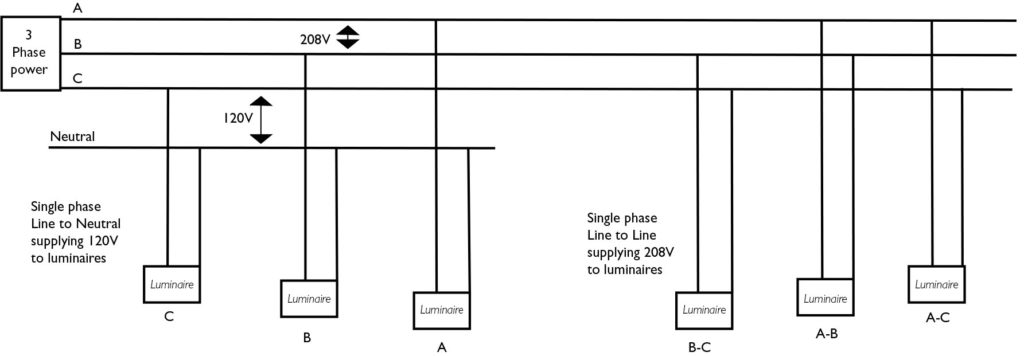
Both single and 3-phase supplies can be configured so that single-phase loads receive either a ‘Line to Neutral Voltage’, or a ‘Line to Line Voltage’.
In a Single-Phase Supply system, the lower voltage (typically 120V) will be the ‘Line to Neutral Voltage’ which is the voltage between one of the lines and the neutral. The higher voltage (typically 240V) will be the ‘Line to Line Voltage’. It will be twice the ‘Line to Neutral Voltage’ and is the voltage measured between the two lines.
In a 3-Phase Supply system, the lower voltage (typically 277V or 347V) will be the ‘Line to Neutral Voltage’ which is the measured voltage between one of the three lines and the neutral. The higher voltage (typically 480V or 600V) will be the ‘Line to Line Voltage’. It will be 1.73x the ‘Line to Neutral Voltage’ and is the voltage between any two of the three lines.
Can I Use a Single-Phase Luminaire If I Have 3-Phase Power Supply?
Yes. Luminaires are single-phase loads, and a 3-phase supply can power them using either one or two of its legs. In a 3-phase supply, you can use all three phases for loads such as motors, fans, and other industrial equipment. Since our luminaires operate on a single phase, you can take advantage of a 3-phase supply using either one or two legs to provide either a single-phase line-to-neutral connection or a single-phase line-to-line connection.
The image below helps demonstrate how you can use a single-phase power supply through a 3-phase power supply to power your luminaires configured using a line-to-neutral voltage and line-to-line voltage.
What Is the Importance of a Stable Power Source, and What Are the Detrimental Results of Brownouts, Blackouts, Etc?
A brownout is a low-voltage condition when the voltage drops. Drivers/Ballasts have a voltage range where they can tolerate a certain percentage of brownouts. Operating the driver outside of this range can be detrimental to the driver or ballast and reduce its lifetime. It is important to consider having your power monitored in your facility. Monitoring your power quality and voltage variation allows corrective measures to be taken to improve the power quality.
Blackouts are when power is turned off and then on again, either momentarily or for prolonged periods. This could potentially be an issue. For facilities still running HID, re-striking lamps more than twice a day is detrimental to lamp and ballast life. LED fixtures restart immediately after an interruption; unlike HID they have no hot-restrike requirement, which is an operational advantage where power is unstable. Power quality still matters for LED drivers, so surge protection and monitoring remain worthwhile. If blackouts are frequent at your facility, consider contacting your utility to resolve the issue, or installing an uninterruptible power supply (UPS) or generator system. HID facilities in these conditions should also keep replacement lamps and parts on hand.
Are There Any Specific Wiring Instructions for LEDs?
LED luminaires are wired based on the voltage required by the light (for example 120, 208, 240, 277, 347, 400, or 480V). Many of our current LED fixtures accept a voltage range. A fixture rated for a continuous range, for example 208-400V, operates anywhere in that range without rewiring, with the driver adjusting to the supplied voltage. Wider family spans such as 208-480V are often covered by two separate driver versions rather than one universal driver, so the range printed on your model’s label is the one that applies. Always confirm on the specification sheet that the exact SKU covers your supply and check the rated output at your voltage. Others are voltage-specific; the accepted voltage or range is always noted on the product label and specification sheet.
LEDs with dimming or dynamic-spectrum capability (such as our control-enabled fixtures) may require separate low-voltage control wiring, typically 0-10V, or wireless control such as MeshIQ or GrowFlux, depending on the control system. This is worth planning at installation time even if you intend to add controls later.
For facilities still operating HID equipment, wiring practice is the same voltage-matching exercise; see your fixture’s spec sheet. Note that a one-to-one retrofit to LED can often reuse much of the existing electrical distribution, subject to an electrical review of conductor and breaker ratings, which is one of the reasons an HPS-to-LED conversion is often simpler than expected (see the ROI of LED for a smart retrofit).
Do I Need to Compensate for Inrush Currents on LED or HID Luminaires?
Inrush current matters, but it is your electrical engineer’s variable to design for, not something to solve at the fixture level. Inrush current occurs in all electronic devices due to their electrical characteristics. The magnitude of the inrush current is based on the design of the electronics and the load. This inrush value needs to be provided by the manufacturer of the luminaire for an engineer to determine the correct electrical equipment to use in the installation. Electrical engineers will select breakers and other electrical devices using inrush as one of many variables to design an electrical system that will function correctly. If inrush is not considered when selecting and sequencing the installation of breakers, nuisance tripping can occur and, in some cases, fusing of contacts on contactors. It is always recommended to consult an electrical engineering company when designing a crop cultivation facility.
How Many Volts Are Grow Lights?
Commercial horticultural fixtures run on supply voltages from 120V to 480V depending on the model. Many current P.L. Light Systems LED fixtures accept ranges within 208-480V, vertical-farming and under-canopy fixtures start at 120V, and HPS fixtures run on 277V to 400V. This is different from hobby and houseplant grow lights, which typically plug into a standard 120V outlet. The fixture table above lists the rated voltage for every model in the current lineup.
Do LED Grow Lights Run on AC or DC?
Both, in sequence. Your facility supplies alternating current (AC); each fixture’s driver converts that AC to the direct current (DC) the LED chips actually run on. That is why the driver, not the diodes, defines the fixture’s rated input voltage range, and why driver quality and power quality protection matter so much for fixture lifetime.
Do Grow Lights Use a Lot of Electricity?
Lighting is one of the largest energy loads in a supplemental-lit greenhouse, which is exactly why fixture efficiency and supply voltage matter. LED fixtures deliver substantially more photons per watt than the HPS technology they replace, and many utility efficiency programs pay rebates for the conversion. Those programs commonly require a fixture to hold a DesignLights Consortium (DLC) Horticultural listing before it qualifies. All P.L. Light Systems LED fixtures carry a DLC Horticultural listing, with the exception of the TriPlane Linear RWMB+FR dual-channel configuration, which is pending. Rebate programs are run by individual utilities, with hundreds of them across North America, and their terms change regularly, so check what your own utility currently offers. For the full economics, see the ROI of LED for a smart retrofit.
Before You Order: The Electrical Checklist
A short list worth walking through with your electrician before specifying fixtures:
- Confirm your available service voltage and whether the connection is line-to-line or line-to-neutral
- Check each fixture’s nameplate input range against your supply on the specification sheet
- Review conductor and breaker ratings, including inrush, for the planned circuit loading
- Plan control wiring (0-10V or wireless) at installation time, even if controls come later
- Confirm surge protection and power quality measures for the driver circuit
- Have the lighting layout and electrical plan reviewed together, so fixture count and circuit design match
How to Get Started
Never assume what voltage you have. Always consult an experienced, certified electrician who can evaluate your facility. Then let us do the lighting side. Share your facility dimensions, available service, and crop targets, and our team will return a light plan with fixture and voltage recommendations. Request a Light Plan or contact our team.
Share your facility dimensions, available electrical service, and target DLI. We return a photometric light plan with fixture and voltage recommendations matched to your site.