Measuring Transmissibility
As the days grow shorter and the glow of supplemental lighting fills greenhouses across the continent, it’s important for growers to understand one often-overlooked factor that directly affects crop performance: transmissibility.
Did you know that the transmissibility of your greenhouse changes throughout the year—depending on your glazing type, coatings, structural design, and even your geography? That’s right—just when you think your plants are getting all the free sunlight they need, seasonal shifts and material factors may be quietly reducing the amount of usable light reaching your crop canopy.
So, the real question is: do you know how much PAR (Photosynthetically Active Radiation) your plants are actually receiving from the sun inside your greenhouse?
What Is Transmissibility?
In simple terms, transmissibility refers to how much sunlight—or more specifically, PAR—passes through your greenhouse covering (such as glass, polycarbonate, or polyethylene film) and reaches your crop.
PAR is the specific range of light wavelengths (400–700 nm) that plants use for photosynthesis. It’s important to note that only about 45% of the sun’s total solar radiation falls within the PAR range. That’s why transmissibility should be measured using instruments that read μmol/m²/s. Watts per square meter (W/m²) is a measure of total solar energy rather than the portion plants can actually use.
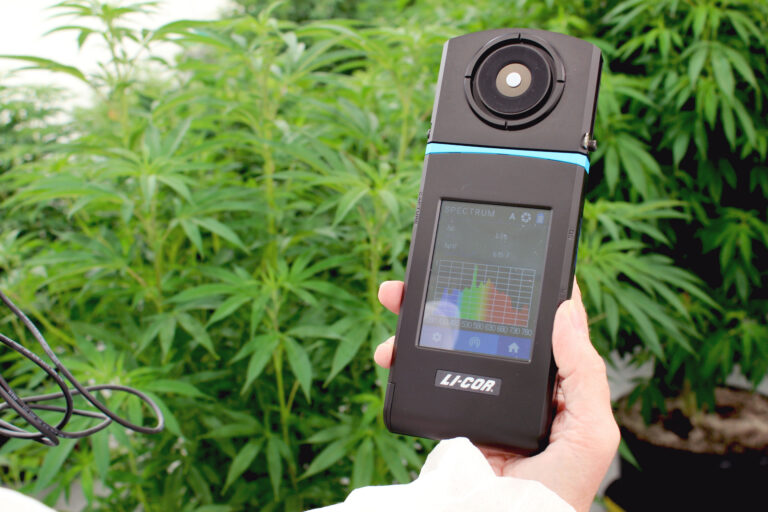
Because of this distinction, growers need a Quantum PAR sensor or a spectrometer designed to measure photons (μmol) rather than energy (watts). These tools ensure you’re measuring the true amount of usable light—or PAR—entering the greenhouse and reaching your crop.
It’s typically expressed as a ratio or percentage comparing the light levels outside the greenhouse to those measured inside, at crop canopy height. A higher transmissibility means more sunlight is reaching your plants, while lower transmissibility can limit light intensity and overall plant growth potential.
How to Measure Transmissibility
Calculating your greenhouse transmissibility is a straightforward process—but accuracy depends heavily on using high-quality instruments and proper testing conditions.
Here’s how to measure it:
- Get a professional light meter or spectrometer.
Tools from manufacturers like LI-COR are industry standards for accurate PAR measurement. - Turn off your supplemental lighting.
You’ll want to measure natural sunlight only to avoid distorted readings. - Take your outdoor reading.
At midday under full-sun conditions, take a light reading outside your greenhouse. This is your Outdoor Light Level. - Take indoor readings.
Measure light levels inside your greenhouse at crop canopy height, avoiding shadows or dark spots. Take several readings throughout the space and average them to determine your Indoor Light Level. - Calculate transmissibility.
Use the following formula:

As a benchmark, typical transmissibility values for greenhouse materials range from 50% to 90%, depending on material and environmental conditions.
What Affects Transmissibility?
A variety of factors influence how much light gets through your greenhouse glazing. Be sure to account for each of these aspects when calculating your transmissibility:
Material Properties:
Each glazing type—glass, polyethylene, acrylic, or polycarbonate—has its own transmission characteristics. Some materials may block certain wavelengths, such as UV radiation, while others allow more diffused light to enter. Age can also play a role in transmissibility of your materials as certain glazing can discolor over time.
Angle of Incidence:
The angle of the sun changes throughout the year. During winter months, when the sun sits lower in the sky, the angle of incidence is reduced—leading to more light reflection on the exterior and less transmission on the interior.
Structural Components:
Support beams, roof angles, and trusses can cast shadows and reduce effective light transmission. That’s why it’s best to take multiple readings at different times of day, and throughout the year.
Coatings and Shading:
Practices like whitewashing and using shade or energy curtains intentionally reduce transmissibility to manage temperature and light intensity—especially in warmer climates.
Geographic Location:
Local weather patterns, latitude, and elevation all impact the quantity and quality of natural sunlight your greenhouse receives.
Why Transmissibility Matters
Understanding your transmissibility is critical for accurately determining your supplemental lighting requirements.
If your greenhouse transmissibility is measured at 90%, that means 10% of your available sunlight (DLI) is being lost before it even reaches your plants. This loss must be factored into your supplemental lighting design to ensure your crops receive the full amount of PAR they need for optimal growth and yield.
Tools like SunTracker Technologies’ DLI software can model Daily Light Integrals (DLI) based on your exact latitude and longitude, providing a precise representation of your region’s average solar radiation over time. These calculations provide PAR measurements outside of the greenhouse in mols/day by month. This measurement must be reduced by the transmissibility of the greenhouse itself. While DLI maps can give general estimates, accurate transmissibility readings from your specific greenhouse are essential for creating a tailored, data-driven light plan.
At P.L. Light Systems, transmissibility measurements form a key part of how we develop customized lighting strategies—ensuring each client’s plan is designed for their specific geography, crop type, and structure. We offer our specialized tools and services to calculate these measurements for growers at no cost or obligation, helping to maximize crop yield and quality.
Measure Today for a Brighter Tomorrow
Knowing your greenhouse transmissibility isn’t just a technical detail—it’s the foundation for consistent, high-quality crop performance. By understanding how much sunlight actually reaches your plants, you can design an effective supplemental lighting strategy that optimizes energy efficiency and yield potential year-round.
Contact P.L. Light Systems today to schedule a transmissibility assessment and discover how precise, real-time data can help you grow smarter this season.
Tell us your crop, structure, and targets. We engineer the rest.